When I first envisioned Bandit Country I was watching Proof of Life. Here I saw a film that had a protagonist who was not a super hero and who did not have a Future Box*. I saw the first inkling of the Big Picture, the Risk - Consequence - Opportunity loop. As I refined that loop I realised that it was missing an element and the Network module was affixed at the centre.
I watched Proof of Life again and I began to notice just how central Network is to the Risk Management resolution scheme of Bandit Country.
Terry Thorne played by Russel Crowe is a Consultant who is engaged to arrange the release of an American engineer who has been kidnapped for ransom. If you are interested in my mindset and the storytelling that I want to emulate, watch the film. The good news is that you can skip any scene that doesn't include Terry.
From the moment that Terry meets Alice and Janice by the pool at the Bowman compound he begins recruiting. He is studied, deliberate and follows basic risk management strategies in everything he does. My early appreciation of the film as a pillar for writing a modern espionage game that is not a Bourne/ Bond clone or a conspiracy game was based on his Risk Management behaviours. In later viewings I began to appreciate that he builds and surrounds himself with a Network and that he arranges and prepares this network to execute his objectives.
To avoid the Bond/Bourne heroic action genre Bandit Country needs to present player goals in terms that they cannot achieve on their own. Even a team of players cannot achieve them with nothing more than their own or specific dedicated resources. The Players will have to recruit the locals to complete their objectives.
The first part of addressing this design goal is that the Players have to define their key tasks in terms of a Risk Management cycle. Even before they perform the task they have assessed it in terms of the risks and the resources they have to apply. This is inherently anti-heroic because heroes are all about doing as they will and adapting to the consequences whereas RM is all about minimising them. RM places the consequences ahead of the benefits and that is a good place to be for some gritty espionage gaming.
Secondly, Recruiting should be fun and achievable. The one thing that all Bandit Country Characters have in common is that they are great recruiters. It is the key ingredient of a consultant. It is also the reason why there is no `Recruit' Specialty. It is automatically assumed that every Consultant is an Elite recruiter. Recruiting has its risks but the Consultant is equipped to manage that because a goal of play is for them to build a Network.
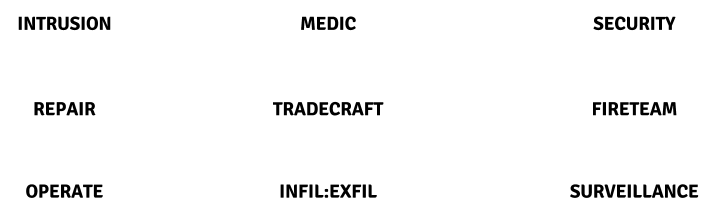
Once they have a Network the real fun begins. Running a Network is a mini-game within the game. I have messed around with it a fair bit and have to playtest more to see where it goes next. Originally I modelled Network building on crafting in video games. If each Recruit is categorised by their Asset (Specialty), connecting them in specific ways builds a structure that is great for a specific role. If I recruit a Fireteam Asset and an Infil:Exfil Asset and a Intrusion Asset, I can link them to make a team that has mobility and can breach security to perform extractions. I could call that a Mobile Extraction Team. This is attractive because it addresses player uncertainty and essentially gives them a menu or shopping list to recruit to. The problem with this approach is to either have to create a long list of combo's or leave it to the GM who is busy enough. Secondly, I really want to see emergent play arise from Networks and defining the structure limits that.
I am currently leaning more in the direction of a boardgame style design (not that it will be played as a boardgame) where each Asset has certain applications (think chess pieces) and can be combined however the recruiter wants. The resulting combination should then be like a machine that performs the task it was designed for (and hopefully succeeds).
One of the core emotional jags that I want to arise through Network play is that the Consultant is using these people. He might convincing them that he is advancing their agenda but his actual interest is in advancing his own. It is quite likely that things will not end well for many of these recruits and that is part of the experience of playing Bandit Country.
*A Future Box is stuffed full of technology and allows for things to be done and discovered without a direct chain of human intervention. We see Future Boxes all the time in film, Jason Bourne consistently befuddles anyone who attempts to use one to engage him. The antihero in the upcoming Watchdogs video games has a cell phone Future Box. The US President and co watched the SEALs kill Bin Laden in one.
Future Boxes are anathema to Bandit Country. The only way to really know what happened is to find out who was there and the only way to do that is to recruit someone to find them. If a consultant wants to have access to the tools of the First World's military and espionage communities, a stupendously risky thing to want, they will have to recruit someone to get that access. Bandit Country makes a story out of the hard road and will never give a Consultant the keys to a Future Box.
Showing posts with label Bandit Country. Show all posts
Thursday, 10 April 2014
Sunday, 30 March 2014
Bandit Country: Why?
I am turning my attention to laying down some serious track towards getting Bandit Country written. I see the roleplaying blogoverse is brimming with nostalgia as the Northern hemisphere begs for Spring time so I have decided to join in.
I have always loved espionage stories. The depth of commitment, the price paid, the marginal reward and the lack of recognition. The first Roleplaying Game I ever bought was Top Secret 1st ed from TSR in 1982. I realize that every game I have ever run has really been an espionage story.
But espionage is a hard genre to find in fiction and film. That might seem like a strange statement but almost everything that claims the espionage genre is just themed action, mystery or conspiracy. Bourne isn't espionage, Bond definitely isn't espionage and neither is Jack Ryan (at least in the films). A good test is whether the protagonist recruits someone to perform a task, usually by lying to them. Another test is whether the protagonist's key objective is to solve a mystery that is actively being concealed from them. If so, it's probably a conspiracy story. If the protagonist is fully aware of their objective but is unable to immediately attain it (thus the recruiting of assets who can bridge to the objective) it is probably espionage.
Bourne is action/conspiracy with espionage trappings. Recent Bonds are the same. Older Bonds are Action/mystery. Burn Notice isn't espionage, it's procedural investigative mysteries (conspiracy for some episodes) with pithy tradecraft voice overs.
Espionage is pretty much anything written by John le Carre; try `The Little Drummer Girl'. It is rare to experience a spy story from the point of view of the asset. `Spy Game' is a great espionage film that also proves that you can incorporate action sequences without breaking the convention. Same with Munich.
My favorite espionage film isn't even generally thought of as being one. It is categorized as an action drama and was generally disliked and poorly reviewed. It has 40% on Rotten Tomatoes and IMDB rates it at 6.2/10. On the other hand it meets the criteria to actually be an espionage film and absolutely sets the template for what a Bandit Country consultant is and does.
Bandit Country: The Risk - Consequence - Opportunity Loop.
After completing my latest work on Rocket Age I am turning back to Bandit Country. If you are new to the blog and you don't know what Bandit Country is, check out this link and check out the back posts.
One of my goals with Bandit Country is to be able to express the game as a series of flowcharts. This is what I call the Big Picture, the primary play loop as a whole.
The Big Picture works like this. The Player selects an Objective for their Consultant and goes through the Risk phase to Assess, Address and Apply a solution. Moving to the Consequence phase we discover the outcomes and apply them. Shifting to the Opportunity phase we find the exploitable circumstances that have emerged from the Consultant's solution and a new Objective is selected. The loop iterates until the Player has achieved their Mission Goal or has been captured and is being tortured to death.
Network sits at the center of the Big Picture because it is informed by each phase of the loop and is protected and enhanced by the Risk Management process. Bandit Country is not a heroic game in the genre meaning of the word and Players will need to recruit, manage and organize one or more networks to achieve their goals.
Risk, Consequence, Opportunity and Network are the four key modules that define a game of Bandit Country. I have written the Risk module and I plan on writing the Consequence and Opportunity modules before the next play-test, 2 weeks.
I am also thinking about how the Network module will work because I want it to be a mini-game within the game as a whole that is simple, strategic and deep. I suspect that I will be looking at card and board games for inspiration there and that will be fun because I don't have much experience with either.
Tuesday, 11 February 2014
Bandit Country Fiction: Cafe Cola
So we’re sitting out front of Cafe Cola, a rusted iron clad shack nestled into the indistinct fringe of the Dantokpa Markets. The miracle of African demarcation and deep understanding of territory means that we are somehow separate from the bustling flood of shoppers. Benoit leans over to clink bottles. “Did you know that Cotonou means `Mouth of the River of Death’?” We are both wearing backpacker tourist gear. Loose button shirts, shorts and sandals. Packs with Canadian flag patches.
He shifts on his yellowing plastic chair. “Most of the slaves passed here on their way to the New World. Prisoners of war sold to the Portuguese. And even now, it is still a market.”
I can smell herbs and leafy vegetables, yams, meat, fish. But mostly I can smell people. African sweat.
Benoit is a native of the French sub species of European expat. Clinging to the cracks of a Post Colonial Africa that is industriously paving over the ghosts of recent history with alternating bricks of war and commerce.
“This is the birthplace of Voodou. One of the better models of human conflict, yes? People have been competing here for as long as there have been people. See how we are not heckled? We are at Cafe Cola. If you took two steps from here you are in a different land. You have crossed a border. Africa is borders.”
We share an easy silence and watch the markets pulse. Women haggling over piled trestles, children working the crowd for dropped coins and the ever flow of colours and smells under a smog of two-stroke fumes. I am told that Benoit originally came to Benin as a part of the security team that oversaw the transfer of French nuclear waste for storage and disposal in the 80’s. But it is hard to wear one hat in Africa. He soon went off the radar and was no doubt stitching new borders of his own.
Across the alley, glimpsed through the passing crowd, a young man is erecting a collapsible satellite dish and then pegging up a dirty sheet to conceal it. Benoit stands; “It is time.”
Sunday, 2 February 2014
Rocket Age: Radium fueled tales of interplanetary adventure
Back in November I wrote about Busy Times. Late last year I wrote the Reddit award winning Flower and then turned my writing attention from the child like Garden Realm to the dark and gritty place where the wants of the first world meet the needs of the developing world in Bandit Country.
At the same time I joined the hallowed fraternity of freelance writers and was fortunate enough to get an opportunity to write for Cubicle 7's Rocket Age. I look forward to posting more about the fruits of that labor when it completes publication.
Busy Times are back because I have been supremely fortunate enough to be asked to write for Rocket Age again, this time as part of a collaborative episodic campaign. This is exciting beyond measure because Rocket Age is an excellent game with a strong sense of purpose and a steady hand on it's guiding principles.
My first encounter with written science fiction as a pre-teen was the Big Three of Asimov, Heinlein and Clarke but my visual experience was Starwars, Battlestar Galactica (original TV) and Flash Gordon. Quite a juxtaposition.
My preference for written Science Fiction drifted through Gibson and Sterling's Cyberpunk to Ian Banks Culture Novels and Dan Simmons Hyperion Cantos. My preference for Science Fiction visually and experientially has drifted back towards the roots.
If you want a primer for everything that is awesome about Rocket Age, check out the Republic Pictures serials, short episodic films that preluded a feature film and primed the audience for the fun times ahead. They peaked from the mid to late 30's, the Rocket Age setting. Radar Men from the Moon is a great start.
Check out Rocket Age. Blast your jets into the deep, wide skies of opportunity. And keep a RAY gun strapped to your hip.
Saturday, 1 February 2014
Bandit Country: Modules
Below are the Modules used during a session of Bandit Country. These Modules interact to form the rules and guidelines of the game and to give the Moderator (GM) some useful tools for creating real-time content if they prefer a more sand-box style of play.
Character
A minigame that Players use to create Consultants. Already described here.
Tempo
This hub module informs all other modules in the game.Tempo generates random numbers for resolution, included as part of a 7 digit number string. These strings can then be used for resolution such as in the Risk Module and True/False booleans for navigating the Consequence and Opportunity Flowcharts.
Tempo also manages Risk mitigation projects used by Players to avoid Consequences.
Risk
A flowchart used by Players to Define Objectives, Assess and Address Risks and then Apply controls and assets to complete Activities and Recruitment. A reflexive Review component of the Risk cycle encourages the Consultant to identify Opportunities.
Consequence
A flowchart used by the Moderator to track outcomes for failed Activities and Recruitment. It outputs Complications and Trauma, the immediate outcomes of failed Risk Mitigation.
It also maintains The Dossier; the evidence that the Consultants leave behind when they take Risks. As The Dossier grows the chance of capture and intervention grows.
Network
A minigame for Players. They can use this module to arrange and rearrange their recruited Assets to better serve their Objectives. Clever Network play might just keep the Dossier out of the hands of the Authorities. Or keeping the Consultant out of the hands of the Authorities if The Dossier is revealed, at the cost of burning the Network.
Opportunity
Drawing from the number strings that feed out of the Tempo Module, the Review component of the Risk Module and the unfavorable outcomes of the Consequence Module, this Module generates real time Candidates (for recruitment), Situations (Risks) and Objectives.
Monday, 27 January 2014
Bandit Country: Test Cover
I got a Wacom Intuos Manga drawing tablet this weekend and so instead of writing I created a mock cover instead. I have to say that I am pleased with the result.
This shader style photo manipulation captures the art style that I want for Bandit Country.
Sunday, 19 January 2014
Bandit Country: First Playtest
Last night I ran the first Playtest of Bandit Country with testers Joe and Ciaran.
We ran through a brief introduction scenario - `The Interview' last night. It incorporated an interview for Risk :: Reward (character creation) and a single objective (recruit a banker). I have included a link to the right. Check it out, it wont make much sense right now because I haven't blogged the key resolution rules of the game but don't let that stop you. It is a living document and I will be updating it with more material as I refine it. `The Interview' will be the introductory scenario for Bandit Country.
As my first playtest I was really pleased with the result. I had been pushed for time in the lead up and my prep was not the best. My PTs didn't get much preamble and the character sheet docs were fairly poor but they jumped in with gusto.
We played over Google Hangouts and that was a positive experience, especially considering that online / remote play is one of my design goals.
Some comments from the PTs about Character creation and the character system as a whole were:
Positives
Wins
We ran through a brief introduction scenario - `The Interview' last night. It incorporated an interview for Risk :: Reward (character creation) and a single objective (recruit a banker). I have included a link to the right. Check it out, it wont make much sense right now because I haven't blogged the key resolution rules of the game but don't let that stop you. It is a living document and I will be updating it with more material as I refine it. `The Interview' will be the introductory scenario for Bandit Country.
As my first playtest I was really pleased with the result. I had been pushed for time in the lead up and my prep was not the best. My PTs didn't get much preamble and the character sheet docs were fairly poor but they jumped in with gusto.
We played over Google Hangouts and that was a positive experience, especially considering that online / remote play is one of my design goals.
Some comments from the PTs about Character creation and the character system as a whole were:
Positives
- Once the `Specialty chain' mini game was figured out it was quick and intuitive.
- It quickly conveyed a sense of just how highly capable the characters are.
- Nine Specialties still allow for variety.
- Assets are neat.
Challenges
- Assets don't make sense until you are using them in-game. They need more definition. I have some ideas about this.
Following the Interview I raised their first Objective: recruit a banker. We then launched into the Risk Management System.
I haven't outlined RMS yet on the blog because I was waiting to see how it worked in actual play. I will be writing more about it soon.
The short version is that whenever players want to do something that has inherent risk they plan it through a basic flowchart that results in them executing their plan and dealing with the consequences.
It is designed to emulate a fiction where contractors are meticulous and deliberate. They plan, have contingencies and consider the risks leading into acting and then review the results. This is the same whether they are in an immediate situation like an ambush or it is an extended situation such as recruiting a target. The only difference is time and scope of action.
Wins
- Within minutes of setting the Objective the PTs were plotting and planning. They looked up Bahraini laws for foreign property investment, checked out his apartment building and sorted out locations for intercepts. They got into the Bandit Country Groove. I was very happy about this. They described this sense of brainstorming as a highlight although it also posed challenges (see below).
- They liked the RMS and Recruitment mechanics.
- The entire play session came down to resolving one Key Objective that nested a couple of sub Objectives and one Recruitment encounter. It is a mechanically light game whilst being structurally heavy.
- The session played out pretty much how I imagined the game should play. This was really satisfying because you never know until you throw it to the wolves.
Challenges
- Explaining the RMS to players is hard. I should have prepared better for that.
- The PTs advised that a better way of presenting a first Objective within the Risk Management System would be to structure it like a `choose your own adventure' rather than the open structure that I used. I agree with this.
- I focused more on the structure of play than the story of the session. This is partly due to minimal preparation and also because I was keeping tabs on the RMS structures and teaching them to the players more than I suspect I will need to in future sessions.
Outcome
I am very pleased with where BC is right now. I know what I need to do next (Blog about the RMS and Recruitment) and also some GM support tools.
Saturday, 11 January 2014
Bandit Country: What is a consultant?
I have revealed how to make a character in Bandit Country and a sample Consultant. So what happens next? What does your Consultant do?
For the Player
Consultants work in the field of Risk Mitigation. Companies such as Risk/Reward, the firm that reached out to Ammar (our sample character), send them to the parts of the world where large capital investment projects (Large Projects) have been made, usually in support of extracting mineral, energy or agricultural resources. And that's where things get complicated.
Millions are invested to extract Billions and specialists are required because these projects are always raised on the promise of building educational and continuous improvement opportunities for the locals. So your Consultant is in-Country assisting local projects according to their Specialties. Ammar for example usually works as a Transportation Systems Consultant. You are on loan to the locals from the benevolent Large Project investors to help make good on the promise that the project will improve the community as a whole.
But that isn't the whole story is it?
You are also a spy. You are watching the human terrain looking for the tipper, the agent of change. You are trying to figure out what will happen next and who will do it. For this you need networks. With your team you will build a priorities list and start recruiting. You will spread a net for rumours and hearsay and will begin to bracket. You will find out who is probing and who is planning. You will identify them and their plans. You will define their structure and fill it with names, locations and capabilities. Then you will determine a response and craft the groundwork. This is called a Package. The Package includes the Threat, it's structure and links to major players, its capabilities. locations and habits. The Package also includes a basic action plan with built in logistics. The Consultants pass the Package to their Firm and they shop it to the stakeholders, foreign intelligence and security services who will pay millions for a concise threat disclosure with organic action plan/ logistics.
Everyone meets for Margaritas and slaps on the back and then redeploy to do it again.
Unless it goes horribly wrong in which case they are either dead, incarcerated or abducted.
Who needs Consultants in the era of the NSA?
The NSA, GCHQ, the Chinese Ministry of State Security, Iranian MISIRI and other Intelligence stakeholders have the realm of signals intelligence all sewn up. They know who is calling who and what they are saying. They have access to the phones and computers. They have access to the infrastructure that carries and switches the data and the vast clouds that hold the data that inform the transactions of the internet.
The kinds of threats that the Consultants hunt don't use the internet. They don't carry phones. They don't have ipads. They build networks of their own where disposable human links tie them to a fringe of one time electronic communicators.
For the GM
Running Bandit Country allows you to layer two discordant narratives and have fun with the result.
Consultants work with local project management on what is typically a specific community improvement project. It could be to do with improving water quality in a city, roads and transport infrastructure linking a port , access to crop harvesting technology, etc. Or they might be involved in a broader national or regional project like a hydroelectric dam or training police forces. This project will threaten to use far more time than they have available and each member of the team will be involved in different aspects of the project or completely different projects. There will be dramas, accidents, bad weather, labor tension and all the other things that happen when money is the sole accelerator for a large project.
At the same time the Consultants are building a Package. The real money in the game they are playing is in the shadowy hand of a major intelligence agency. They need to start recruiting and get some ears to the ground. They need to find a threat that is saleable. They need to develop some contingencies and start shopping it on the market. The more Threats they find the more assured their parent company is in its role as a Risk Mitigator to the Large Project. This game can be warmly heroic in the sense of the Consultants uncovering and shopping the solution to a serious terrorist plot. It can be bleakly cynical in the sense of the Consultants building a network and converting it into a straw-man threat, ensuring the triumph of fear when it is shopped to an Agency of the key investor nation.
Consultant, welcome to Bandit Country.
Wednesday, 8 January 2014
Bandit Country Character Creation Example
If this is not making sense, check out the prior Bandit Country posts on Character Creation.
Ammar al-Bagdhadi
Ammar was successfully running a band of street thugs watching over local businesses, essentially a protection racket (Surveillance). Following the invasion and as things got worse in Baghdad he built them into a network getting people out of the country (Infil:Exfil). This proved to be very successful and he even set up a small company doing roadworks in Baghdad. He `redeployed' some of the road-working machinery to improve Highway 10, the trunk road linking Baghdad to Amman in Jordan (Operate).
In early 2004 the CIA caught up with him. They had been watching him for a while and when they confirmed that he was not affiliated with any of the insurgency groups (a rarity) they recruited him. For the next 6 months he underwent rigorous training and preparation. Ammar had never been academically minded and he found the schooling quite arduous but emerged with very high competency (Tradecraft).
By late 2004 the second Battle of Fallujah was in full swing and Ammar was deployed to the Sunni triangle. He continued with his people smuggling, passing the refugees through a CIA filter. A number of mid level insurgent leaders were captured and the operation was considered a success. It was a difficult time and Ammar spent nearly as much time fixing damaged vehicles as he did finding and transporting customers (Repair).
This and other similar operations continued over the next 7 years. His network had a reputation on the black market and he was able to shift from moving people to goods as the state of affairs improved in Iraq with the surge in 2008.
By 2010 the drawdown was in full effect and most of the foreign troops were gone from Iraq. Ammar's handlers were by this time far more interested in Iranian influence than in domestic driven insurgency.
Ammar spent a few years in Basrah. Using road works contracts as cover, he ran several small operations scoping out Iranian agents of influence. These operations grew in scope from basic surveillance and time/ motion studies to breaking into safehouses to photograph documents (Intrusion). Ammar was not comfortable with the way the operational tempo was escalating and felt that his CIA handlers were pushing too hard.
In early 2013 Ammar was shot while exiting a safe house in Baghdad. His team got him out and he survived but it was the end of his time with the Agency. They told him that he was burned, paid him some money and that was the end of his career as an Agent.
Ammar's first asset is Documents 3. His connection to the Iraqi government bureaucracy from the early days has paid off.
His second Asset is Techs 3. This asset represents his team that he ran in Baghdad and Basrah. He can use them for Intrusion, Surveillance or Operate. These guys work in the construction business but will do some work on the side for Ammar.
Ammar al-Bagdhadi
Specialities
Ammar was 16 at the time of the US invasion of Iraq in 2002. A streetkid in Baghdad, his parents had vanished during a purge five years earlier and his wider family had done little more than give him a place to hide when he caused more than the usual amount of trouble. Ammar was successfully running a band of street thugs watching over local businesses, essentially a protection racket (Surveillance). Following the invasion and as things got worse in Baghdad he built them into a network getting people out of the country (Infil:Exfil). This proved to be very successful and he even set up a small company doing roadworks in Baghdad. He `redeployed' some of the road-working machinery to improve Highway 10, the trunk road linking Baghdad to Amman in Jordan (Operate).
In early 2004 the CIA caught up with him. They had been watching him for a while and when they confirmed that he was not affiliated with any of the insurgency groups (a rarity) they recruited him. For the next 6 months he underwent rigorous training and preparation. Ammar had never been academically minded and he found the schooling quite arduous but emerged with very high competency (Tradecraft).
By late 2004 the second Battle of Fallujah was in full swing and Ammar was deployed to the Sunni triangle. He continued with his people smuggling, passing the refugees through a CIA filter. A number of mid level insurgent leaders were captured and the operation was considered a success. It was a difficult time and Ammar spent nearly as much time fixing damaged vehicles as he did finding and transporting customers (Repair).
This and other similar operations continued over the next 7 years. His network had a reputation on the black market and he was able to shift from moving people to goods as the state of affairs improved in Iraq with the surge in 2008.
By 2010 the drawdown was in full effect and most of the foreign troops were gone from Iraq. Ammar's handlers were by this time far more interested in Iranian influence than in domestic driven insurgency.
Ammar spent a few years in Basrah. Using road works contracts as cover, he ran several small operations scoping out Iranian agents of influence. These operations grew in scope from basic surveillance and time/ motion studies to breaking into safehouses to photograph documents (Intrusion). Ammar was not comfortable with the way the operational tempo was escalating and felt that his CIA handlers were pushing too hard.
In early 2013 Ammar was shot while exiting a safe house in Baghdad. His team got him out and he survived but it was the end of his time with the Agency. They told him that he was burned, paid him some money and that was the end of his career as an Agent.
Assets
Ammar's first asset is Documents 3. His connection to the Iraqi government bureaucracy from the early days has paid off.
His second Asset is Techs 3. This asset represents his team that he ran in Baghdad and Basrah. He can use them for Intrusion, Surveillance or Operate. These guys work in the construction business but will do some work on the side for Ammar.
Now
Ammar has recovered from his gunshot wound and is facing the next stage in his life. He was recently visited by a polite man who knew all kinds of things about Ammar's activities over the past decade. The man asked Ammar if he wanted to do more? He left a card. Risk/Reward. Ammar is reaching for his phone.
Monday, 6 January 2014
Bandit Country: Creating a Character
The Character creation mini game:
This is rough and unedited but gives you an idea of how it works. Refer to prior Bandit Country posts if this isn't making sense.
Each Character starts with 2 Assets. Using the chart below, from the Start point in the Centre, chart the path from the Entry to the Defining Speciality. The number in the final box indicates that Asset. The Asset score equals the number of steps.
This is rough and unedited but gives you an idea of how it works. Refer to prior Bandit Country posts if this isn't making sense.
Specialties
- Select 2 Specialties and Draw a line through them. These are Untrained.
- Select an Entry Specialty and draw a Circle around it. It is at Elite level training, the highest. This Specialty is what got you noticed and engaged in your previous career. It is also the Specialty that best suits your personal ability. It seems easy to you because it caters to your natural strengths.
- Select a Defining Specialty and draw a Circle around it. This one is also at Elite level Training. You had to work for this one. Gaining the highest capability in this Specialty is one of your career highlights. The results you can achieve with this Specialty represent your aspirations.
- Select a Transition Specialty and draw a Box around it. This one and all the remaining Specialties are rated at Professional level training. This one stands out because it is the reason you got out of your prior career and became a Consultant.
- Now it is time to draw your career path. Starting with your Entry Specialty, draw an arrow to a neighbouring Specialty either horizontally, vertically or diagonally. You cannot link an Untrained Specialty. An eligible Specialty can only have one arrow coming in and one going out. Arrows can only link to a neighbouring Specialty. Continue linking your Specialties until you get to your Defining Specialty. Now, following the same process link it to the Transition Specialty. When you are done you will have a single path of arrows extending from your Entry Specialty to your Defining Specialty and then to your Transition Specialty. The Untrained Specialties are unlinked.
- If you want you can create a professional history for your character.
Starting with the Entry Specialty, write a sentence or two that describes an Event that was important in the Character’s life in the context of that Specialty. Take as much license as you need to chart your Character’s successes, failures and dramatic moments. Maybe the event impacts the Character, someone they care for or a professional or personal competitor, either way, it is meaningful in your Character’s life. Follow the arrows and repeat for each Specialty in order. The Untrained Specialties do not get events.
The three key Specialties that deserve special attention are the Entry, Defining and the Transition Specialties. The Entry Specialty should be a story of success; how a rookie with talent got noticed and gained entry into the elite circles of their profession. The Defining Specialty should be one of struggle and challenge; a professional achievement at personal cost. The Transition Specialty story should be one of change and coping; did the Character initiate the change? How thoroughly have they coped with it? How has it changed their relationships with ex-colleagues and personal acquaintances?
Assets
Assets are a contact and the resource that the contact can be tapped for.
Assets
Intrusion:- Break In Team
Repair:- Aircraft Mechanic
Operate: Welder
Medic:- Mobile Trauma Team.
Tradecraft: Analysis / Red Team.
Infil:Exfil: Transport
Security: Bodyguards
Fireteam: Raid
Surveillance: Watchers
|
Go to Start and chart from Defining to Transition Speciality. Again, the number of steps equals the Asset Score.
1
|
2
|
3
|
4
|
5
|
8
|
5
|
1
|
7
|
6
|
7
|
3
|
START
|
4
|
7
|
6
|
8
|
2
|
6
|
8
|
5
|
4
|
3
|
2
|
1
|
Wednesday, 1 January 2014
Bandit Country: Character Components
Character creation in Bandit Country is, of course, a mini-game. I want it to engage Players right from the start. I want to introduce the mindset of the game and for the Players to rub up against its limitations even as they define their avatar.
Why Limitations? Bandit Country is not a heroic game, at least in the gaming sense of the word. Characters are limited and this is intended to create a friction. But I am getting ahead of myself here so let's start with the components of a Character: Specialties and Assets.
SPECIALTIES
I chose these nine Specialties to define the risk taking activities that a Contractor can engage in while on an operation. Risk and Risk Management are at the core of the mechanics of the game and define the stories that will be told while playing Bandit Country.
Specialties can be ranked Elite, Professional or Civilian according to the choices the Player makes during character creation.
You will notice that the Specialties are all `doing things'. Specialties define what a Contractor does, not what they know. There are no academic specialties such as forensics or interpersonal specialties such as interrogation. This cuts to the core of what Players do in the game.
Bandit Country is a game of building human intelligence networks at great risk for customers who will not support them if things go pear shaped. Every Contractor is a superb recruiter. That's why they got the job. If the team needs an academic expert to complete their objective they will need to recruit one. Or use an Asset.
ASSETS
Assets are packages of pre-configured capabilities. They are rated from 1, low to 9, high. An Asset can represent a Specialty. For example a standby team of break and enter Techs could be Intrusion 3. It can be a line of credit, $300,000; Funds 5. It can be an accessible resource; Safehouse 4.
Assets by default are burned as they are used. Otherwise they have some sort of conditional refresh. For example, the Break Team refreshes following a Report to the Stakeholders.
Contractors start with some Assets and Players can negotiate more during operations. Players can also develop their own Assets during play.
Wednesday, 4 December 2013
Bandit Country: Design Sources
I am currently pursuing two strains of research to realise my design for Bandit Country.
I read the Guardian and New York Times for all things Snowden. The recent big reveal on the scale of SigInt surveillance is one of the boundaries within Bandit Country that the player characters must contend with. A radar if you like that they will want to stay below.
I read Foreign Affairs because it is a great 'big picture, little footprint' window into the world of nation states. It also has great interviews with interesting people who have stood in the spotlight (and those who more interestingly, avoided it) such as Stanley McChrystal.
I read AllAfrica and Council on Foreign Relations: Africa for setting information. I want to set the initial AEO of Bandit Country in West Africa, a region on the fringe of the next emerging proxy wars.
Finally, I am reading about Operational Risk Management and systems of Project Management. This is fairly dry going but it is helping me shape up the core mechanics of the game.
If you know of any sources that could help, please comment.
Saturday, 30 November 2013
Slaying the Demon, Fleeing before the Storm
Did I complete NaGaDeMon?
Yes and no.
I wrote a game and played it.
The game is Bandit Country and it is incomplete. It is also very promising so I will not be posting it at this time.
Bandit Country is shaping up to be something special. I look forward to posting more about it and sharing how the QTE ethic has influenced my design and writing.
Saturday, 23 November 2013
Bandit Country: Components, Tools and Apps.
Bandit Country includes four Components, the sections that encompass the rules of the game:
- Character
- Activity
- Recruiting
- Exposure
The Players and GM use two Tools, really just functions of a clock, for resolution, tension and plot development:
- Stopwatch
- Timer
The Players and GM can play Bandit Country with the following smartphone / tablet Apps:
- Notepad
- Clock
- Maps
- Search
Monday, 18 November 2013
What is Bandit Country?
BANDIT COUNTRY is my RPG for NaGaDeMon.
Bandit Country is the RPG of espionage and covert action for-hire. Players adopt the role of contractors in the shady world of freelance intelligence and special activities. Private enterprise, individuals and governments all have conflicting objectives and sometimes they need things done quickly, quietly and with minimal overhead. These stakeholders often operate complex systems of surveillance and digital intrusion but lack the `soft assets’, the human networks that are the ultimate enabler if the agency ever needs to directly interact `in country’. Your job is to identify a need and set up these networks and franchise them off or better yet, find a commission or patron who will provide tasking and a budget to match.
PILLARS OF DESIGN
- TIME. Time is always counting up and down. Everything that matters is measured by time. Stopwatch and countdown are important tools for resolution and plot progression.
- REAL. These Stories could be real. A Risk economy will be a key component of play.
- MOBILE. The game can be played using the apps on a smartphone. Maps, clock, search. The game will be easily played online so no `components’ required. How does this affect character representation?
- HUMAN. BC is about the human angle. The big players have the sophisticated tools. The contractors have locality, the willingness to adopt risk and specific skill sets.
Sunday, 17 November 2013
Busy Times
No posts over the previous few months but some significant successes to make up for it.
The Drakkeil campaign is going really well and I am learning (and remembering) more about the art of moderating and writing content for a game. You have to be your own editor and that is a difficult task if you don't want to slink about on trope crutches. Jeff has continued to refine 5x5 and it remains my goto game for genre emulation.
I decided to get serious about writing and sent in a sample to a line developer of a new game when I discovered an open call for submissions on rpg.net. This lead to a request to submit an idea for an adventure which I did and was then asked to write it up. I did that and after going through several lengthy iterations it is now with the editor. It has been a great learning opportunity and I look forward to being able to blog further about it.
After reading blogs for a long time I decided to actually look around the web and find roleplaying communities beyond the safe and familiar boundaries of rpgbloggers.com. I discovered /r/rpg and shortly thereafter they hosted their inaugural Weekend RPG Jam competition which I am honored to say I won. I worked hard on my game Flower, I encourage you to check it out and let me know what you think. Over December I am going to teach myself Scribus or some similar layout alchemy and I will prettify and update Flower and release it to the wild.
And my daughter just turned 8 weeks old.
Today I discovered National Game Design Month. Only 14 days to go but hey, I'm gonna economize, I'm gonna rework a game I have been romancing for years but never really wrote in any coherent form. In less than 2 weeks you will locate my secrets, turn my people and evade my security and while the big Agencies are feeling the political leash in this post Snowden age, the contractors are running wild in Bandit Country.
Subscribe to:
Posts (Atom)